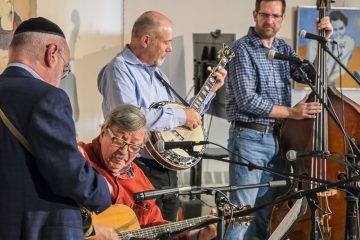
East Nash Grass came together out of a standing gig at a club in—well, you guessed it—East Nashville, and has since coalesced into a creative unit at the top of the contemporary bluegrass scene. Fiddle player and former college golf champion Maddie Denton just won the IBMA Fiddle Player of the Year award, and ENG won the IBMA New Artist of the Year award in 2024. Besides Maddie, ENG consists of Harry Clark (mandolin), James Kee (guitar), Jeff Partin (bass/dobro), and Cory Walker (banjo—also the brother of Jarrod Walker, who plays mandolin with Billy Strings). Collectively, they represent alumni of stellar bands including the Dan Tyminski Band, the Wooks, Rhonda Vincent and the Rage, Ricky Skaggs and Kentucky Thunder, and Sierra Hull.
With all that stellar bluegrass experience (plus a bunch of awards), it’s no surprise that they’ve brought a myriad of influences to ENG, which are beautifully presented on their latest album, All God’s Children, released in August 2025. Despite the title, this is not a gospel work, though the title track has a spiritual feel to it—both in the sense of being “meaningful” and in its connection to spiritual music as a genre. Harry Clark, one of the co-authors, has denied that All God’s Children has any specific referent, though you can definitely read the lyrics as a narrative about going to the Burning Man Festival!
The next song, “Hill Country Highway,” also written by Harry Clark, is a straight-up bluegrass traveling-musician song: part lament about being away from home, part celebration of the rambling lifestyle. “Followin’ You” (note the spelling), sung by Maddie Denton, feels a little different from the first two songs, with much more prominent dobro. Because of the dobro, its short length, and its classic love-song theme, one could imagine it on a contemporary country album, albeit with somewhat different instrumentation.
On the other hand, “Git Along Little Yearlings,” sung by Harry Clark, is an old Jimmy Driftwood cover and is surprisingly faithful to the source material. Stellar mandolin crosspicking leads into a harrowing story of a wagon train escaping the devastation of the Civil War, with appropriately prominent fiddle breaks giving it a Western feel. But straight off the melancholy waltz time of “Git Along,” “In Such a Short Time” puts the drive into hard-driving bluegrass, with fiddle, banjo, and mandolin breaks that push the laws of nature. “Short Time” offers an interesting contrast between vocal delivery and instrumental breaks: James Kee, the guitarist, kind of hangs back with an almost languid style, while the instruments—especially mandolin and fiddle—push the beat hard. It’s great bluegrass, with the mandolin break destined for legendary status.
“The Love We Gave Up” was both written and sung by bass player Jeff Partin; it’s his only lead vocal on the album, which goes to show that any one of their singers could front just about any other band. Harry Clark says that the seventh track, “Bend in the Road,” was loosely inspired by relatives who would take road trips out West to work—but perhaps thinking too hard about the lyrics isn’t necessary here, as the frantic road-trip vibe is probably sufficient.
“Redbird,” on the other hand, slows things down again and gives Maddie Denton a chance to shine on a more relaxed, country/Americana groove. It’s a sad song, written by and originally performed by Nashville singer-songwriters Amanda Fields and Megan McCormick, with the aforementioned red bird (a cardinal, according to the songwriters) evoking the memory of a loved one who has passed on.
Mountain Fever Records