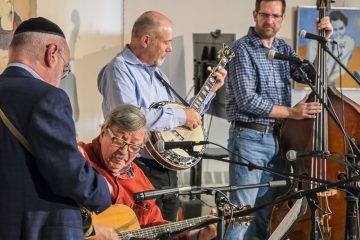
Drift, the title of Wes Corbett’s new album, might be somewhat of a misnomer, for this recording does anything but lose its focus or fall off course. This is Corbett’s second solo outing, but in case you’re unaware, Corbett’s illustrious track record has seen him on the faculty at Boston’s Berklee College of Music, as the banjo-playing member of the noted genre-defying group Joy Kills Sorrow, stints touring with Molly Tuttle and currently with the great Sam Bush.
Continuing the tradition of keeping good musical company Wes decided to invite a stellar group of musicians to join on the making of Drift. Currently a resident of Nashville, he assembled an A-list of players to join him in the studio and impart their musical personalities into the journey that Drift takes you on. In addition to a dozen or so of Nashville’s session-players’ finest, there’s the venerable mandolin of Sam Bush and Sierra Hull, Bryan Sutton and Chris Eldridge on guitars and Darol Anger’s violin providing considerable input into Corbett’s compositions. Rounding out the ensemble crew are Casey Campbell (mandolin), Bronwyn Keith-Hynes, Jason Carter and Brittany Hass on fiddle, Justin Moses on dobro, and the bass work of Paul Kowert, Todd Phillips, Mike Bub and Vickie Vaughan.
The Tracks
“Care of the Mundes” begins traditionally enough as a tribute to the great Alan Munde, followed by a sweet succession of solos after Wes’s opening statement of the melody. After the guitar, dobro and fiddles chime in it returns back to Wes taking the listener on an ever- climbing chromatic show of tension to bring it up and back down. After adding a lovely turn-around it’s brought back home with everyone eventually joining in and a clever three-time tag to close it out.
“Salmon Run”. This one is true to its title expressing the frenetic energy of a salmon run. The tune has great momentum and energy just like the salmon who swim upstream. The tempos are breathtaking and convey what’s needed to swim against the tide. Sutton’s guitar solo is a stand-out.
On “Eagle Harbor”, Drift may seem to meander to take a turn in atmosphere, but it’s journey progresses smartly to take us through Indian modal inspiration and a blend of styles evoking Emo, a somewhat wistful ballad that combines to defy a specific genre. Bluegrass artists are currently redefining the genre as it’s been known, and influences are being beautifully incorporated to gather a new diverse audience. Wes Corbett’s varied background (after all, what kind of musician teaches banjo at arguably the world’s ostensibly prestigious school known for jazz?)
is taking bluegrass on a journey it hasn’t yet been, and the results are engaging and impressive, while remaining true to its traditions.
The stand-out single from the album, “Hartford’s Bend on the Cumberland” takes us for a ride on what one might imagine it might sound like on Captain John Hartford’s antique steam-powered riverboat, the Julia Belle Swain, as he piloted it down the Mississippi. Corbett used Hartford’s actual Eb banjo on his solo and says “it’s the banjo-iest tune I’ve ever written in my life, and, I hope, a loving tribute to John”.
“The Tide Pool Jigs” begins with a lovely banjo dissonance that expresses a subtle sadness when it remembers that it actually becomes a jig with a quick turn in tempo and a shift from minor to major to exclaim its exciting uplifting finale.
“Stratford Blues”. The title only provides a glimpse of where we’re about to be taken. A winning combination of styles in a single tune that defies what one might refer to as “the blues”. Think Duke Ellington decided to write bluegrass for an ensemble (not his big band), and you might get the idea.
“Riptide”. We return to the theme of water as Corbett makes his minor/major shift evoking the push and pull of a rip current. Its energy threatens to drag you out to sea, but this shanty won’t pull you under because it’s ultimately a buoyant, bouncy track.
“The Shrouded Valley”. At once sad and mysterious it reveals a melody that has the decided feel of the great American West, as if inspired by the musical landscapes of Aaron Copeland or even Rogers and Hammerstein’s Oklahoma. The piece retains a mystery throughout but the melancholy bowed bass at its conclusion makes you wonder if you ever really got to see what was hidden in the first place. This tune reinforces that in addition to Corbett’s banjo chops, his composing and arranging are enthralling.
“Shapeshifter” takes you on a rhythmic, chromatic banjo-rolling journey that energetically leads up to greater heights with key changes that transitions the mood up to its lofty conclusion of the ride leaving you off at its peak.
“Crane Island”. Not sure where Crane Island is located, but the feel of the water is all around you as you’re taken on a playful ride beginning with the banjo and trading off with clever play between the mandolin and fiddles as the rest of the ensemble joins in and the rhythmic chop on the jaunt brings you ashore.
Wes Corbett’s Drift has taken us on a ride that has had multiple destinations and never once becomes mundane. Corbett provides us with a joyful musical collaboration of many led by a significant talent who has on this second solo submission created an important contribution to this ever-changing and surprising music some call bluegrass.
Adhyâropa Records